Gujarat Technological UniversityWinter 2024 examination

GTU 3151911 Dynamics of Machinery Winter 2024 Question Paper & PDF

B.E. · Mechanical Engineering · Semester 5 · Subject code 3151911
Download official PDFView PDF here
Share with your class
Total
70 marks
To pass
23 marks (33%)
Duration
2.5 Hours 10:30 AM – 1:00 PM
Questions
5 with internal choice
No solutions on this paper yetNeed them for your exam? Ask once. Papers that students ask for are solved first, and we aim to add them within 24 hours.

Q.1

14 Marks
(a)
3 marks
What is the significance of inertia forces in reciprocating engines?
(b)
4 marks

Why is the correction couple applied while considering the inertia of the connecting rod of a reciprocating engine?

(c)
7 marks

In a vertical double-acting steam engine, the connecting rod is 4.5 times the crank. The weight of the reciprocating parts is 120 kg and the stroke of the piston is 440 mm. The engine runs at 250 rpm. If the net load on the piston due to steam pressure is 25 kN when the crank has turned through an angle of 120° from the top dead centre. Solve for thrust in the connecting rod, pressure on slide bars, and tangential force on the crank pin, thrust on the bearings, and turning moment on the crankshaft using the above information.
Q.2

14 Marks
(a)
3 marks

Compare the effect of Primary and Secondary Unbalanced Forces of Reciprocating Masses.

(b)
4 marks

Explain the following terms using neat sketches and equations

1Variation of Tractive Force
2Swaying Couple
(c)
7 marks

A four-crank engine has two outer cranks set at 120° to each other, and their reciprocating masses are each 400 kg. The distance between the lanes of rotation of adjacent cranks are 450 mm, 750 mm, and 600 mm. If the engine is to be in complete primary balance, find the reciprocating mass and the relative angular position for each of the inner cranks. If the length of each crank is 300 mm, the length of each connecting rod is 1.2 m and the speed of rotation is 240 rpm., Calculate the maximum secondary unbalanced force.

(c)
7 marks

A shaft supported in bearings that are 1.6 m apart projects 400 mm beyond bearings at each end. It carries three pulleys one at each end and one at the centre of its length. The masses of the end pulleys are 40 kg and 22 kg and their centres of mass are 12 mm and 18 mm respectively from the shaft axes. The mass of the centre pulley is 38 kg and its centre of mass is 15 mm from the shaft axis. The pulleys are arranged in a manner that gives static balance. Calculate the

irelative angular positions of the pulleys and
iidynamic forces developed on the bearings when the shaft rotates at 210 rpm.

Q.3

14 Marks
(a)
3 marks

Illustrate following terms in context to mechanical vibration

1Period of vibration
2Cycle
3Frequency
(b)
4 marks

Derive the expression for natural frequency of free longitudinal vibration through “Energy method”.

(c)
7 marks

The mass of a turbine rotor of a ship is 8000 kg and has a radius of gyration of 0.75 m. It rotates at 1800 rpm clockwise when viewed from the stern. Determine the gyroscopic effects in the following cases: (a) If the ship traveling at 100 km/h steers to the left along a curve of 80 m radius. (b) If the ship is pitching and the bow is descending with maximum velocity. The pitching is with simple harmonic motion with periodic time of 20 s and the total angular movement between extreme positions is 10°. (c) If the ship is rolling with an angular velocity of 0.03 rad/s clockwise when looking from stern. In each case, determine the direction in which the ship tends to move.

(a)
3 marks
Explain following terms with neat sketches:
1Longitudinal vibration
2Lateral vibration
3Torsional vibration
(b)
4 marks

Derive the expression for natural frequency of free longitudinal vibration through “Rayleigh’s method”

(c)
7 marks

A turbine rotor of a ship is of 2000 kg mass and has a radius of gyration of 0.8 m. Its speed is 2000 rpm. The ship pitches 5° above and below the mean position. A complete oscillation takes place in 20 s and the motion is simple harmonic. Calculate (a) the maximum couple tending to shear the holding down bolts of the turbine, (b) the maximum acceleration of the ship during pitching, and (c) the direction in which the bow will tend to turn while rising, if the rotation of the rotor is clock-wise, when looking from aft.

Q.4

14 Marks
(a)
3 marks

Discuss the effect of inertia of the shaft in longitudinal and transverse vibrations.

(b)
4 marks

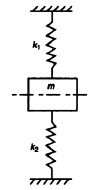
Evaluate the natural frequency of a vibratory system shown in figure. The mass of block is m and stiffness of springs are k1 and k2.

GTU Dynamics of Machinery (3151911) Winter 2024 Question 4(b) Diagram
(c)
7 marks

A spring-mass system consists of a spring of stiffness 350 N/m. The mass is 0.35 kg. The mass is displaced 20 mm beyond the equilibrium position and released. The damping coefficient is 14 Ns/m. Calculate (a) critical damping coefficient, (b) damped natural frequency, and (c) logarithmic decrement.

(a)
3 marks
Explain the term ‘dynamic magnifier’.
(b)
4 marks

A cylinder partially depressed slightly and released. Evaluate the natural frequency assuming that it stays upright all the time. Where x = displacement of the cylinder, A = cross sectional area of the cylinder, m = mass of the cylinder, ρ = specific gravity of the river water.

(c)
7 marks

A vibrating system consists of a mass of 30 kg, a spring of stiffness 20 kN/m and a damper of damping factor 0.25. Calculate:

athe critical damping coefficient
bthe natural frequency of damped vibrations
cthe logarithmic decrement, and
dthe ratio of two successive amplitudes.

Q.5

14 Marks
(a)
3 marks

Compare the displacement-time curves for following damping conditions.

1Under damped
2Over damped
3Critically damped
(b)
4 marks
Represent the expression for natural frequency of free transverse vibrations.
(c)
7 marks

The rotor of a turbine of mass 15 kg is supported at the mid-span of a shaft of span 0.4 m. The rotor has an unbalance of 0.003 kg m. Determine the force exerted on the bearings at a speed of 6000 rpm. The diameter of steel shaft is 25 mm and E = 200 Gpa.

(a)
3 marks
Explain logarithmic decrement for free damped vibration
(b)
4 marks
Illustrate all the forces graphically for forced damped vibration.
(c)
7 marks

A circular disc having 10 kg mass in mounted at mid span of 25 mm diameter shaft supported by two bearings. Due to manufacturing inaccuracy, the mass centre is shifted by 0.025 mm away from the geometric centre of the disc of the span between two bearings is 500 mm and the shaft rotates at 4000 rpm, determine the amplitude of vibration and reactions on the bearings. Take modulus of elasticity E = 2 x 10¹¹ N/mm²

More Dynamics of Machinery papers

Questions repeat across sessions. Working through two or three papers shows you which topics GTU asks most.

Preparing with friends?

Send this paper to your class group. Every question has its own link.

About this paper

Official Gujarat Technological University (GTU) examination paper for Dynamics of Machinery (Winter 2024, B.E. · Mechanical Engineering, Sem 5). Features complete 70-mark regular & remedial examination pattern, official marking distribution across all 5 questions, and direct 1-click official PDF download.

Transcribed for student exam preparation from Gujarat Technological University official examination archives. Questions, syllabus guidelines, and curriculum marking schemes remain the intellectual property of Gujarat Technological University.

ViewDownload PDF