Gujarat Technological UniversityWinter 2023 examination

GTU 3151911 Dynamics of Machinery Winter 2023 Question Paper & PDF

B.E. · Mechanical Engineering · Semester 5 · Subject code 3151911
Download official PDFView PDF here
Share with your class
Total
70 marks
To pass
23 marks (33%)
Duration
2.5 Hours 10:30 AM – 1:00 PM
Questions
5 with internal choice
No solutions on this paper yetNeed them for your exam? Ask once. Papers that students ask for are solved first, and we aim to add them within 24 hours.

Q.1

14 Marks
(a)
3 marks

Explain the need of balancing of rotating and reciprocating masses. Explain the effects of unbalancing in rotating and reciprocating masses.

(b)
4 marks
Define the terms:
iNatural frequency,
iidamping,
iiifree vibrations,
ivamplitude of vibration
(c)
7 marks

The four masses P1, P2, P3 and P4 having their radii of rotation as 100 mm, 120mm, 250 mm and 300 mm respectively. The angles between the masses P1 & P2, P2 & P3 and P3 & P4 are 450, 700 and 1400 respectively. Find the position and magnitude of the balancing masses required located at the radius of 350 mm. Use mass value of P1 = 200 KG, P2=250 KG, P3=150 KG,P4=100 KG
Q.2

14 Marks
(a)
3 marks
Define terms:
iTurning moment diagram,
iiCoefficient of fluctuation of energy in case of flywheel,
iiiCritical or whirling speed of shaft
(b)
4 marks

Explain the term vibration isolation. List the different materials used as isolation materials with their applications.

(c)
7 marks

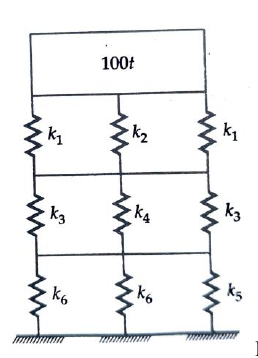
Find the natural frequency of the system shown in figure 2.1. Mass supported by spring is 100 tones. K1 = K2 = K3 = K4 = K5 = K6 = K= 1000 N/m.

GTU Dynamics of Machinery (3151911) Winter 2023 Question 2(c) Diagram
(c)
7 marks

A flywheel rotating at a maximum speed of 250 rpm and is having radius of gyration of 0.5 m is attached to a punching press. The press is driven by a constant torque electric motor and punches 750 holes per hour. Each punching operation requires 14000 Nm of energy and takes 1.8 seconds. If the speed of the flywheel is not to fall below 225 rpm, find

ipower required by the motor and
iimass of the flywheel.

Q.3

14 Marks
(a)
3 marks

Draw and explain the turning moment diagram of multi-cylinder in line four stroke engine.

(b)
4 marks
State and explain D’Alembert’s principle.
(c)
7 marks

In IC engine mechanism, the crank radius is 400 mm and connecting rod is 950 mm long. The diameter of piston is 100 mm and net gas pressure acting on the piston is 15 MPa. Find

ithrust on connecting rod,
iipiston side thrust,
iiitorque acing on the crank shaft.
ivload on main bearings when crank has made of 45° from TDC.
(a)
3 marks
List the types of damping and explain any one of it.
(b)
4 marks

Explain the effect of active and reactive gyroscopic couple on the aeroplane taking right turn looking from tail end and propeller rotating in clockwise direction.

(c)
7 marks

A turbine rotor weighing 9800 N rotates at 2000 rpm clockwise when viewed from stern. The vessel pitches with an angular velocity of 0.5 rad/sec. Calculate the gyroscopic couple during the rise of the bow if rotor has radius if gyration of 254 mm. Explain the effect of reactive gyroscopic couple on the ship.

Q.4

14 Marks
(a)
3 marks

Derive an expression for natural frequency of torsional vibration of a disc connected at the end of the shaft.

(b)
4 marks

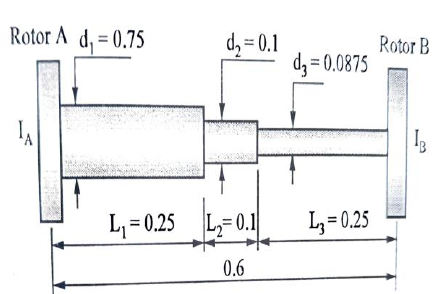
Find the equivalent length of the system given below considering the diameter of equivalent shaft as 0.0875 m.

GTU Dynamics of Machinery (3151911) Winter 2023 Question 4(b) Diagram
(c)
7 marks

The successive amplitudes of vibrations of vibratory system as obtained under free vibrations are 0.69, 0.32, 0.19, 0.099 units respectively. Determine the damping ratio of the system. Also determine the natural frequency of un-damped vibrations if time period of damped vibration is 0.5 seconds.

(a)
3 marks

Explain the methods of measurement of displacement and velocity of vibrating bodies.

(b)
4 marks
Draw and explain the two regions of vibration control on transmissibility curve.
(c)
7 marks

A vertical single stage air compressor having a mass of 500 Kg is mounted on springs having stiffness of 1.96 * 10⁵ N/m and damping factor of 0.20. The rotating parts are completely balanced and the equivalent reciprocating parts weigh 20 Kg. The stroke is 0.2 m. Determine the amplitude of steady state vibration of vertical motion and the phase difference between the motion and excitation force if the compressor is operated at 200 rpm.

Q.5

14 Marks
(a)
3 marks
Why the shape of the crank is made like this (shown in the figure)?
GTU Dynamics of Machinery (3151911) Winter 2023 Question 5(a) Diagram
(b)
4 marks
Explain the procedure of balancing of V-engines.
(c)
7 marks

In an in-line six-cylinder engine working on two stroke cycle, the cylinder center lines are spaced at 600 mm. In the end view, the cranks are 60° apart and in the order 1-4-5-2-3-6. The stroke of each piston is 400 mm and the connecting rod length is 1 meter. The mass of the reciprocating parts is 200 kg per cylinder and that of rotating parts 100 kg per crank. The engine rotates at 300 r.p.m. Examine the engine for the balance of primary and secondary forces and couples. Find the maximum unbalanced forces and couples.

(a)
3 marks

What is Hammer blow? Derive an expression for limiting speed required for hammer blow.

(b)
4 marks

Derive an expression for critical speed of shaft carrying a single rotor and having no damping.

(c)
7 marks

A rotor having a mass of 5 kg is mounted midway on a simply supported shaft of diameter 10 mm and length 400 mm. Because of manufacturing tolerances, the CG of the rotor is 0.02 mm away from the geometric center of the rotor. If the rotor rotates at 3000 rpm, find the amplitude of steady state vibrations and the dynamic force transmitted to the bearings. Neglect the effect of damping. Take E = 2 *10¹¹ N/m².

More Dynamics of Machinery papers

Questions repeat across sessions. Working through two or three papers shows you which topics GTU asks most.

Preparing with friends?

Send this paper to your class group. Every question has its own link.

About this paper

Official Gujarat Technological University (GTU) examination paper for Dynamics of Machinery (Winter 2023, B.E. · Mechanical Engineering, Sem 5). Features complete 70-mark regular & remedial examination pattern, official marking distribution across all 5 questions, and direct 1-click official PDF download.

Transcribed for student exam preparation from Gujarat Technological University official examination archives. Questions, syllabus guidelines, and curriculum marking schemes remain the intellectual property of Gujarat Technological University.

ViewDownload PDF