Gujarat Technological UniversitySummer 2026 examination

GTU 3151911 Dynamics of Machinery Summer 2026 Solved Paper & Solutions

B.E. · Mechanical Engineering · Semester 5 · Subject code 3151911
Download official PDFView PDF here
Share with your class
Total
70 marks
To pass
23 marks (33%)
Duration
2.5 Hours 2:30 PM – 5:00 PM
Questions
5 with internal choice
25 step by step solutions on this page

8 of 25 questions on this paper were also asked in other years. 7 more are types of question GTU sets again with new data. Each is marked below with the years it appeared.See all 21 repeated 3151911 questions, most asked first

Q.1

14 Marks
(a)
3 marksAsked in 3 of 4 papers
State D’Alembert’s principle and explain its significance in dynamic analysis.

Also asked in Summer 2025 Q3b, Summer 2023 Q4a

(b)
4 marksSame type asked in 3 of 4 papers

Calculate the inertia force in a slider-crank mechanism given crank speed and dimensions.

Also asked in Summer 2025 Q3c, Summer 2023 Q2c OR

(c)
7 marks

Analyze a three-rotor torsional vibration system and determine its natural frequencies.

Q.2

14 Marks
(a)
3 marksAsked in 3 of 4 papers

Analyze the effect of gyroscopic couple on the stability of a two-wheeler during a turn.

Also asked in Summer 2025 Q3b OR, Summer 2023 Q1a, Summer 2023 Q5b

(b)
4 marksSame type asked in 4 of 4 papers

An aeroplane makes a complete half circle of 60 m radius towards left when flying at 250 km/h. The rotary engine and the propeller of the plane have a mass of 450 kg with a radius of gyration of 300 mm. The engine runs at 2400 rpm clockwise when viewed from the rear. Find the gyroscopic effect on the aircraft.

Also asked in Summer 2025 Q2c, Summer 2024 Q4c, Summer 2024 Q4c OR, Summer 2023 Q5c

(c)
7 marksSame type asked in 3 of 4 papers

A spring-mass system consists of a spring of stiffness 350 N/m. The mass is 0.35 kg. The mass is displaced 20 mm beyond the equilibrium position and released. The damping coefficient is 14 N.s/m. Determine (a) critical damping coefficient, (b) damped natural frequency, and (c) logarithmic decrement.

Also asked in Summer 2024 Q2c, Summer 2023 Q4c OR

(c)
7 marksSame type asked in 3 of 4 papers

A vibrating system consists of a mass of 30 kg, a spring of stiffness 20 kN/m and a damper of damping factor 0.25. Calculate: (a) the critical damping coefficient (b) the natural frequency of damped vibrations (c) the logarithmic decrement, and (d) the ratio of two successive amplitudes.

Also asked in Summer 2024 Q2c, Summer 2023 Q4c OR

Q.3

14 Marks
(a)
3 marks
Propose design modifications to prevent resonance in high-speed rotors.
(b)
4 marks

Compare the characteristics of turning moment diagram for a single cylinder engine and multi-cylinder engine.

(c)
7 marksSame type asked in 3 of 4 papers

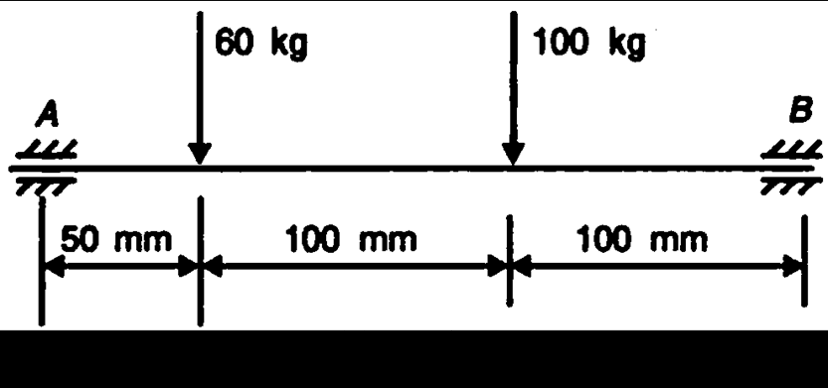
A solid shaft of uniform diameter is supported by two short-bearings as shown in Figure 1. The above shaft carries two discs having concentrated masses of 60 kg and 100 kg respectively. Determine the fundamental frequency of vibration if the moment of inertia of the shaft is 40 x 10⁴ mm⁴ and damping at the bearing is neglected.

GTU Dynamics of Machinery (3151911) Summer 2026 Question 3(c) Diagram

Also asked in Summer 2025 Q5c, Summer 2024 Q2c OR, Summer 2024 Q4b

(a)
3 marks
Propose safety considerations for operating near critical speed.
(b)
4 marksAsked in 2 of 4 papers
Analyze the role of a flywheel in punching presses.

Also asked in Summer 2025 Q1b

(c)
7 marks

A motor drives a centrifugal pump through gearing. The speed of the pump is one- third of the speed of the motor. The diameter of pinion shaft is 40 mm and it is 300 mm long. The mass moment of inertia of motor is 400 kgm². The gear shaft, on which impeller of centrifugal pump is mounted, has 60 mm diameter and is 600 mm long. The mass moment of inertia of the impeller is 1500 m². Neglecting the inertia of gear and pinion, determine the natural frequency of torsional vibration.

Q.4

14 Marks
(a)
3 marksAsked in 2 of 4 papers
Explain logarithmic decrement and its use.

Also asked in Summer 2024 Q5a OR

(b)
4 marks
Analyze the effect of damping on the critical speed of a horizontal shaft.
(c)
7 marksSame type asked in 3 of 4 papers

A single cylinder vertical petrol engine of total mass 300 kg is mounted upon a steel chassis frame and causes a vertical static deflection of 2 mm. The reciprocating parts of the engine has a mass of 20 kg and move through a vertical stroke of 150 mm with simple harmonic motion. A dashpot is provided whose damping resistance is directly proportional to the velocity and amounts to 1.5 kN per meter per second. Examine the effect of forced vibration considering that the steady state of vibration is reached and determine the amplitude of forced vibrations, when the driving shaft of the engine rotates at 480 r.p.m., and the speed of the driving shaft at which resonance will occur.

Also asked in Summer 2025 Q5c OR, Summer 2023 Q3c OR

(a)
3 marksAsked in 2 of 4 papers
Explain vibration isolation and Transmissibility.

Also asked in Summer 2025 Q5a

(b)
4 marks
Examine the effect of resonance in rotating shafts.
(c)
7 marks

Analyze the effect of damping on frequency Forced Vibrations under Under damped condition using graphical method.

Q.5

14 Marks
(a)
3 marksAsked in 4 of 4 papers
Define static and dynamic balancing with examples.

Also asked in Summer 2025 Q1a, Summer 2024 Q2b, Summer 2023 Q5a

(b)
4 marks
Explain the concept of primary and secondary balancing in reciprocating engines.
(c)
7 marksSame type asked in 3 of 4 papers
The following data refer to an outside cylinder uncoupled locomotive:

Mass of rotating parts per cylinder = 350 kg Mass of reciprocating parts per cylinder = 300 kg Angle between cranks = 90o Crank radius = 0.3 m Cylinder centers = 1.8 m Radius of balance masses = 0.8 m Wheel centers = 1.5 m If whole of the rotating and 2/3rd of the reciprocating parts is to be balanced in planes of the driving wheels, find (a) magnitude and angular positions of balance masses, (b) speed in km/h at which the wheel will lift off the rails when the load on each driving wheel is 30 kN, and the diameter of tread of driving wheels is 1.8 m

Also asked in Summer 2025 Q4c, Summer 2023 Q1c

(a)
3 marksAsked in 2 of 4 papers

Define imaginary crank using neat sketch with regard to the balancing of reciprocating secondary unbalanced forces.

Also asked in Summer 2024 Q3a OR

(b)
4 marksAsked in 2 of 4 papers

Explain the partial balancing of primary unbalanced forces in single cylinder reciprocating engine.

Also asked in Summer 2024 Q3c OR

(c)
7 marks

A twin cylinder V-engine has the cylinders set at an angle of 45°. The connecting rods are 30 cm long and the crank radius is 70 mm. The total rotating mass is equivalent to 3 kg at the crank radius and the reciprocating parts mass is 2 kg per line. A balance mass is fitted opposite to the crank equivalent to 2.5 kg at a radius 10 cm. The engine speed is 2000 rpm. What the value of maximum resultant secondary force.

More Dynamics of Machinery papers

Questions repeat across sessions. Working through two or three papers shows you which topics GTU asks most.

Preparing with friends?

Send this paper to your class group. Every question has its own link.

About this paper

Official Gujarat Technological University (GTU) examination paper and step-by-step solutions for Dynamics of Machinery (Summer 2026, B.E. · Mechanical Engineering, Sem 5). Features complete 70-mark regular & remedial examination pattern, official marking distribution across all 5 questions, and direct 1-click official PDF download.

Transcribed for student exam preparation from Gujarat Technological University official examination archives. Questions, syllabus guidelines, and curriculum marking schemes remain the intellectual property of Gujarat Technological University.

ViewDownload PDF