Q.1
14 Marks(a)
Explain the Whirling Speed of a Shaft
(b)
Explain the Dynamical Equivalent System of two masses.
(c)
Analyze the forces like Piston effort and force acting along the connecting rod.
Noted. This paper is in our queue now. Check back tomorrow.
We could not record that here. Email the paper name to hirenjsca@gmail.com and we will add it.
5 of 25 questions on this paper were also asked in other years. 6 more are types of question GTU sets again with new data. Each is marked below with the years it appeared.See all 21 repeated 3151911 questions, most asked first
Also asked in Summer 2026 Q5a, Summer 2025 Q1a, Summer 2023 Q5a
The mass of a single degree damped vibrating system is 7.5 kg and makes 24 free oscillations in 14 seconds when disturbed from its equilibrium position. The amplitude of vibration reduces to 0.25 of its initial value after five oscillations. Determine : 1. stiffness of the spring, 2. logarithmic decrement, and 3. damping factor, i.e. the ratio of the system damping to critical damping.
Also asked in Summer 2026 Q2c, Summer 2026 Q2c OR, Summer 2023 Q4c OR
A shaft 1.5 m long, supported in flexible bearings at the ends carries two wheels each of 50 kg mass. One wheel is situated at the centre of the shaft and the other at a distance of 375 mm from the centre towards left. The shaft is hollow of external diameter 75 mm and internal diameter 40 mm. The density of the shaft material is 7700 kg/m³ and its modulus of elasticity is 200 GN/m². Find the lowest whirling speed of the shaft, taking into account the mass of the shaft.
Also asked in Summer 2026 Q3c, Summer 2025 Q5c
List the criteria for selection of reference plane for balancing masses rotating in multiple plane.
Apply Rayleigh’s method to derive natural frequency of free transverse vibrations for a shaft subjected to a number of point loads.
Analyze the effect of unbalanced forces on V-engine and derive the relation for secondary unbalanced force.
Also asked in Summer 2026 Q5a OR
Also asked in Summer 2025 Q5a OR, Summer 2023 Q2a
Also asked in Summer 2026 Q5b OR
Apply Rayleigh’s method to determine natural frequency of free longitudinal vibration.
A cantilever shaft 50 mm diameter and 300 mm long has a disc of mass 100 kg at its free end. The Young's modulus for the shaft material is 200 GN/m². Determine the frequency of longitudinal and transverse vibrations of the shaft.
Also asked in Summer 2026 Q3c, Summer 2025 Q5c
The rotor of the turbine of a ship has a mass of 2500 kg and rotates at a speed of 3200 rpm counter-clockwise when viewed from stem. The rotor has radius of gyration of 0.4 m. Determine the gyroscopic couple and its effect when
Also asked in Summer 2026 Q2b, Summer 2025 Q2c, Summer 2023 Q5c
An instrument vibrates with a frequency of 1 Hz when there is no damping. When the damping is provided, the frequency of damped vibrations was observed to be 0.9 Hz. Find 1. the damping factor, and 2. logarithmic decrement.
A rear engine automobile is travelling along a track of 100 metres mean radius. Each of the four road wheels has a moment of inertia of 2.5 kg-m² and an effective diameter of 0.6 m. The rotating parts of the engine have a moment of inertia of 1.2 kg-m². The engine axis is parallel to the rear axle and the crankshaft rotates in the same sense as the road wheels. The ratio of engine speed to back axle speed is 3:1. The automobile has a mass of 1600 kg and has its centre of gravity 0.5 m above road level. The width of the track of the vehicle is 1.5 m. Calculate the limiting speed of the vehicle around the curve for all four wheels to maintain contact with the road surface. Assume that the road surface is not cambered and centre of gravity of the automobile lies centrally with respect to the four wheels.
Also asked in Summer 2026 Q2b, Summer 2025 Q2c, Summer 2023 Q5c
Compare the Frequency of Free Damped Vibrations under following situations using a graph amplitude vs time period.
Each crank and the connecting rod of a four-crank in-line engine are 200 mm and 800 mm respectively. The outer cranks are set at 120° to each other and each has a reciprocating mass of 200 kg. The spacing between adjacent planes of cranks are 400 mm, 600 mm and 500 mm. If the engine is in complete primary balance, determine the reciprocating masses of the inner cranks and their relative angular positions. Also find the secondary unbalanced force if the engine speed is 210 rpm.
Identify the significance of Damping Factor and Logarithmic Decrement for damped vibration
Also asked in Summer 2026 Q4a
Demonstrate the Dunkerley’s method to determine the Natural Frequency of Free Transverse Vibrations For a Shaft Subjected to a Number of Point Loads
A rotor is completely balanced when masses of 2 kg and 1.2 kg are added temporarily in planes A and D each at 200 mm radius as shown in Fig. 1. The balanced mass in the plane A is along the x-axis whereas in the plane D, it is at 120° counter-clockwise. It is desired that the actual balancing is to be done by adding permanent masses in planes B and C, each at 120 mm radius. Determine the magnitudes and the directions of the masses B.
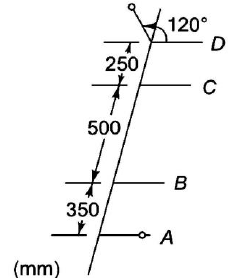
Also asked in Summer 2023 Q3c
Questions repeat across sessions. Working through two or three papers shows you which topics GTU asks most.
BE Mechanical
Send this paper to your class group. Every question has its own link.
Official Gujarat Technological University (GTU) examination paper for Dynamics of Machinery (Summer 2024, B.E. · Mechanical Engineering, Sem 5). Features complete 70-mark regular & remedial examination pattern, official marking distribution across all 5 questions, and direct 1-click official PDF download.
Transcribed for student exam preparation from Gujarat Technological University official examination archives. Questions, syllabus guidelines, and curriculum marking schemes remain the intellectual property of Gujarat Technological University.
3151911 Dynamics of Machinery
Official GTU PDF · Summer 2024
The PDF could not be loaded from the university's website.
Open the PDF directly