Q.1
14 MarksAn ideal source is a source whose output does not change with the load.
- An ideal voltage source gives a fixed terminal voltage for any current. Its internal resistance is zero.
- An ideal current source gives a fixed current for any voltage. Its internal resistance is infinite.
| Ideal source | Practical source |
|---|---|
| No internal resistance (voltage source) | Has a small internal resistance |
| Terminal voltage is constant | Terminal voltage falls as when load current rises |
| Can give unlimited power | Power is limited |
| Only a model | Real battery or generator |
Statement: In a linear bilateral network with more than one independent source, the current in any branch (or voltage across any element) is the algebraic sum of the values produced by each source acting alone, with all the other independent sources removed.
How to apply it:
- Keep one source and replace the others: a voltage source by a short circuit, a current source by an open circuit. Internal resistances stay.
- Find the required current or voltage due to this source.
- Repeat for every source and add the results with their signs.
Example: a 10 V source is in series with a 5 resistor, and a 2 A source is connected across this branch, both pushing current the same way. With 10 V alone the current is A. With the 2 A source alone it is 2 A in the same direction through the 5 resistor. Total current A.
It holds only for linear circuits, so it cannot be used for power, as power depends on the square of the current.
Find the Thevenin’s equivalent and Norton’s equivalent of the circuit with respect to terminals a and b.
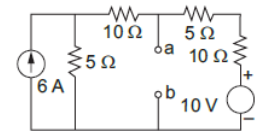
The 6 A source with the 5 resistor in parallel is the same as a 30 V source in series with 5 . Adding the 10 resistor, the left branch is 30 V with 15 . The right branch is the 5 and 10 in series, which is 10 V with 15 . Both sources act in the same direction towards .
The two branches are in parallel between and :
Remove the sources (voltage source short, current source open). The two 15 branches are in parallel:
Check: short and . The short circuit current is A.
 Thevenin            Norton
  7.5 ohm
 o--/\/\/--+         o--+-------+----o a
           |            |       |
         20 V        2.667 A  7.5 ohm
           |            |       |
o---------+ o--+-------+----o bThevenin equivalent: V in series with . Norton equivalent: A in parallel with .