Gujarat Technological UniversitySummer 2024 examination

GTU 3150911 Power System- II Summer 2024 Question Paper & PDF

B.E. · Electrical Engineering · Semester 5 · Subject code 3150911
Download official PDFView PDF here
Share with your class
Total
70 marks
To pass
23 marks (33%)
Duration
2.5 Hours 2:30 PM – 5:00 PM
Questions
5 with internal choice
No solutions on this paper yetNeed them for your exam? Ask once. Papers that students ask for are solved first, and we aim to add them within 24 hours.

Q.1

14 Marks
(a)
3 marks
Explain advantages of per unit system for power system calculations.
(b)
4 marks

Following three generators are connected in parallel. Generator G1 = 10 MVA, 10 kV, X” = 10%; Generator G2 = 12 MVA, 10.6 kV, X” = 15%; Generator G3 = 15 MVA, 12 kV, X” = 20%. Find the overall equivalent per unit reactance of these the system considering 20 MVA, 11 kV system base.

(c)
7 marks

Three loads are connected in parallel across a 1400 V rms, 60 Hz single phase supply as follows: Load 1: Inductive load, 125 kVA at 0.28 power factor Load 2: Capacitive load, 10 kW and 40 kvar Load 3: Resistive load of 15 kW.

iFind the total kW, kvar,, kVA and the supply power factor
iiDetermine the kvar rating of a capacitor (of negligible resistance) and capacitance in μF to improve the power factor to 0.8 lagging.
iiiFind the reduction in current after PF improvement.
Q.2

14 Marks
(a)
3 marks
Why synchronous compensators can supply leading as well as lagging vars?
(b)
4 marks
Discuss why equivalent π of a long line is preferred to the equivalent T circuit.
(c)
7 marks

What is a receiving end power circle diagram? How can it be drawn? What information does it provide?

(c)
7 marks

What is nominal circuit? Find ABCD constants for nominal π and nominal T circuits of a transmission line?

Q.3

14 Marks
(a)
3 marks
What is meant by doubling effect? Explain in brief.
(b)
4 marks

List various types of faults and write the relative frequency of occurrence of various types of faults.

(c)
7 marks

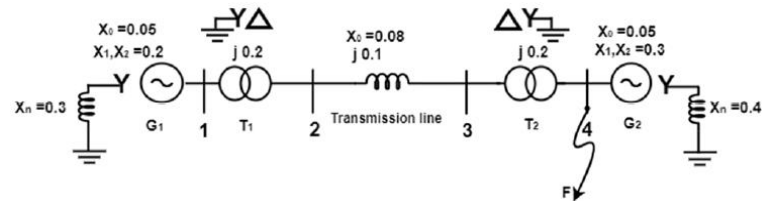
A 4 bus network given in Fig. 1 with following positive, negative and zero sequence reactances: G1 : X0 = 0.06 pu; X1=X2 = 0.2 pu G2: X0 = 0.05 pu; X1=X2 = 0.3 pu T1 & T2 : X0 = X1=X2 = 0.2 pu Transmission line: X0 = 0.08 pu; X1=X2 = 0.1 pu G1 and G2 neutral ground reactance = 0.3 pu A fault occurs at bus 4 phase R. Draw sequence impedance diagram and find the fault current in p. u. [PTO]

GTU Power System- II (3150911) Summer 2024 Question 3(c) Diagram
(a)
3 marks

Why are we interested in computation of sub-transient current rather than steady sustained short-circuit current?

(b)
4 marks

The Line currents in amperes in phases a, b, c respectively are 500 + j150, 100 – j600 and -300 + j600 referred to the same reference vector. Find the symmetrical components of currents?

(c)
7 marks

What is bus impedance matrix? Explain the method of fault calculation using bus impedance matrix.

Q.4

14 Marks
(a)
3 marks
What is the reason for transients during short circuit?
(b)
4 marks

Prove that positive sequence and negative sequence impedance of fully transposed transmission line are always equal.

(c)
7 marks

Using appropriate interconnection of sequence networks, derive the equation for a line to line fault in a power system with faults impedance of ZfZ_f.

(a)
3 marks
What are symmetrical components and its need?
(b)
4 marks
Explain in brief phase shift of symmetrical components in Y-∆ transformer banks.
(c)
7 marks

Draw the waveforms for fault current for a 3-phase fault on alternator terminals. Explain the sub-transient, transient and steady state reactance. What is their significance in fault calculations?

Q.5

14 Marks
(a)
3 marks
Explain methods to reduce corona loss in brief.
(b)
4 marks
Why the disruptive critical voltage is less than visual critical voltage.
(c)
7 marks

Discuss the phenomenon of wave reflection and refraction. Derive expression for reflection and refraction.

(a)
3 marks
Explain the phenomena of corona.
(b)
4 marks
State factors affecting corona loss and discuss in brief.
(c)
7 marks

Find the critical disruptive voltage and critical voltages for local and general corona on a 3-phase overhead transmission line, consisting of three stranded copper conductors spaced 2.5 m apart at the corners of an equilateral triangle. Air temperature and pressure are 21° C and 73 cm Hg respectively. The conductor diameter, irregularity factor and surface factor are 10.4 mm, 0.85, 0.7 and 0.8 respectively.

More Power System- II papers

Questions repeat across sessions. Working through two or three papers shows you which topics GTU asks most.

Preparing with friends?

Send this paper to your class group. Every question has its own link.

About this paper

Official Gujarat Technological University (GTU) examination paper for Power System- II (Summer 2024, B.E. · Electrical Engineering, Sem 5). Features complete 70-mark regular & remedial examination pattern, official marking distribution across all 5 questions, and direct 1-click official PDF download.

Transcribed for student exam preparation from Gujarat Technological University official examination archives. Questions, syllabus guidelines, and curriculum marking schemes remain the intellectual property of Gujarat Technological University.

ViewDownload PDF