Q.1
14 MarksUsing Kirchhoff’s Voltage Law (KVL), calculate the current flowing through a 2 Ω resistor in a simple series circuit containing a 12 V battery, a 2 Ω resistor, and a 4 Ω resistor.
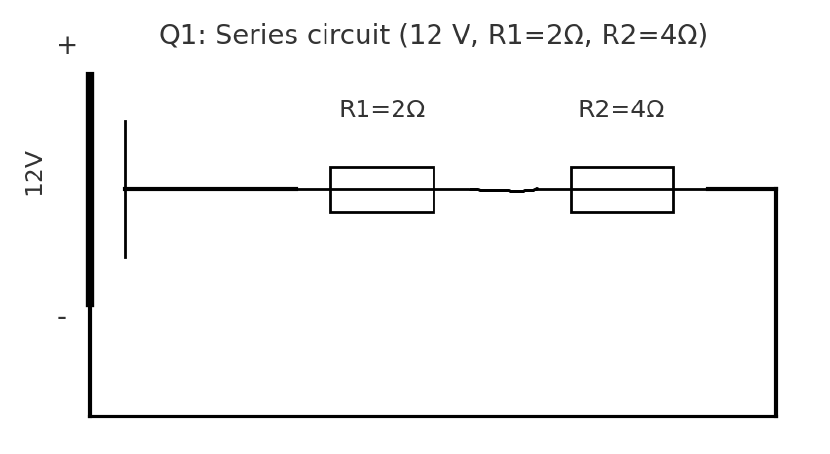
Kirchhoff's Voltage Law (KVL) states that the algebraic sum of all the voltages around a closed loop is zero. The supply voltage equals the sum of the voltage drops.
In the series circuit, the same current flows through both resistors.
The current through the resistor is A, because the same current flows in a series circuit.
For the given circuit, apply Thevenin’s Theorem to determine the current flowing through a 6 Ω load resistor connected across two terminals. (Assume: a 24 V source with 4 Ω and 8 Ω resistors in series, load of 6 Ω connected across the 8 Ω resistor terminals.)
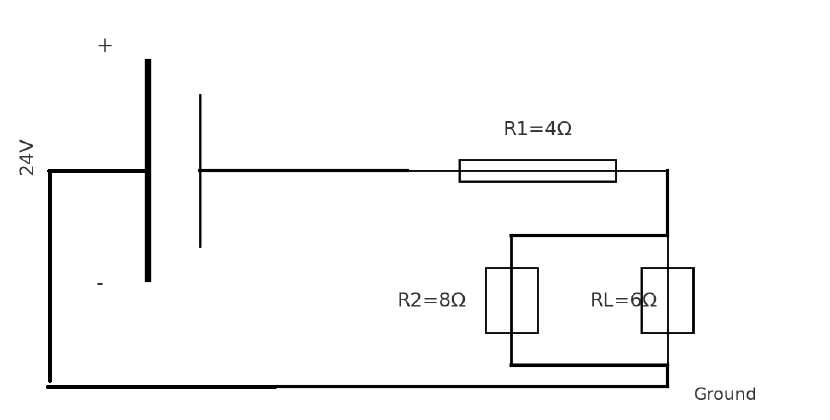
Thevenin's theorem: a network seen from two terminals can be replaced by a voltage source in series with a resistance .
From the figure: V, , , and the load is connected across .
The terminals are across . With removed, the voltage across is found by the voltage divider.
Short the V source. and are in parallel as seen from the terminals.
The current through the load is about A.
A DC circuit consists of three resistors: R1 = 10 Ω, R2 = 20 Ω, and R3 = 30 Ω, connected in a star configuration. Convert this star network into its equivalent delta network, and calculate the resistance values of each branch of the delta.
The three star resistances are , , , joined at terminals , and .
Each delta resistance is the sum of the products of the star resistances, taken two at a time, divided by the star resistance that is opposite to it.
The equivalent delta has , and .