Q.1
14 MarksKirchhoff's Current Law (KCL) states that the algebraic sum of the currents meeting at a node (junction) is zero. In other words, the total current entering a node equals the total current leaving it.
Demonstration: at a node, 5 A and 3 A flow in, and two branches carry the current out.
   I1 = 5 A ----\
                 (node)----> I3 = 6 A
   I2 = 3 A ----/       \--> I4 = 2 A
Current in = A. Current out = A. They are equal, so KCL holds. KCL is based on the conservation of charge: no charge is stored at a node.
Let be the rms voltage, the rms current and the phase angle between them.
- Active (true) power : the power that does useful work and is used up by the load. , unit watt (W).
- Reactive power : the power that moves back and forth between the source and the inductor or capacitor, and does no useful work. , unit volt-ampere reactive (VAR).
- Apparent power : the product of the rms voltage and current. , unit volt-ampere (VA).
- Power factor: the ratio of active power to apparent power. .
The three powers are related by . The power factor is lagging for an inductive load and leading for a capacitive load, and its value is between 0 and 1.
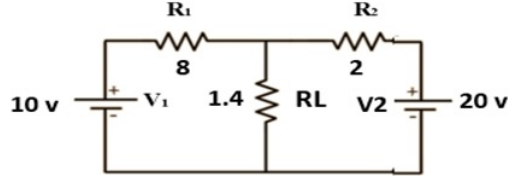
Thevenin's theorem: any linear network, seen from two terminals, can be replaced by a voltage source in series with a resistance .
From the figure: V, , , V, .
With removed, the two sources and , form one loop. The current in the loop is
The voltage across the open terminals is
Check: V.
Replace each source by a short circuit. and are then in parallel as seen from the terminals.
Connect to the Thevenin equivalent circuit.
The current through the load resistance is A.