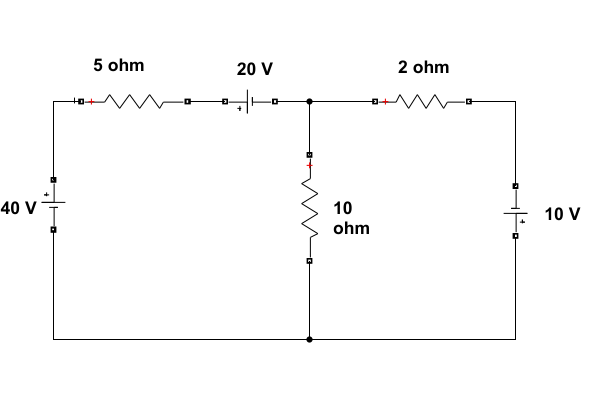
Q.1
14 MarksCalculate current, resistance and energy consumed by an electric iron rated 230 V, 2 KW when used for 12 hours. What is the monthly energy bill at Rs. 5/- per unit?
Also asked in Winter 2024 Q5b OR, Summer 2024 Q5c OR, Winter 2023 Q5a
- Voltage rating () =
- Power rating () =
- Operating duration () =
- Days in month =
- Tariff rate =
- 1. Current ():
- 2. Resistance ():
- 3. Daily Energy Consumed:
- 4. Monthly Energy Consumed & Energy Bill:
- Current drawn:
- Resistance:
- Energy consumed (for 12 hours):
- Monthly electricity bill (30 days): Rs. 3600/-
Draw various types of alternating waveforms. Label peak, peak-to-peak, RMS and average value on sinusoidal AC waveform. Why are sinusoidal voltages preferred over other alternating voltages?
- Sinusoidal Wave: Standard smooth periodic AC waveform ().
- Square Wave: Jumps abruptly between positive and negative peak levels.
- Triangular Wave: Constant linear rise and linear fall.
- Sawtooth Wave: Slow linear rise followed by an instantaneous vertical drop.
- Peak Value (): The maximum instantaneous amplitude attained during a half cycle.
- Peak-to-Peak Value (): Total vertical difference between positive and negative peaks:
- RMS Value (): The effective heating equivalent of DC voltage:
- Average Value (): The mean value over one half-cycle:
- Mathematical Invariance: The derivative and integral of a sine wave is also a sine wave. It passes through inductors and capacitors without waveform distortion.
- Easy Generation: Simple rotating coils in a uniform magnetic field naturally generate pure sine waves.
- Minimal Harmonic Losses: Non-sinusoidal waveforms contain higher-order harmonics causing eddy current losses, motor vibration, and acoustic noise.
- Efficient Transformation: Essential for smooth operation of transformers and AC electrical machines.
Sinusoids maintain waveform shape through reactive circuits (), produce zero harmonic losses, and are naturally generated by rotating AC alternators.
Write basic guidelines (Safety Rules) regarding the safe handling of electricity and electrical appliances. Mention various types of electrical safety devices.
- De-energize & Lockout-Tagout (LOTO): Always isolate the power supply and lock the main disconnect switch before inspecting or repairing circuits.
- Use Insulated Tools: Always handle tools with rubber/PVC insulated grips rated for the operating voltage ( rated).
- Wear Personal Protective Equipment (PPE): Wear dry rubber gloves, safety goggles, and rubber-soled electrical hazard footwear.
- Never Work in Wet Conditions: Water drastically reduces skin resistance, increasing shock fatality.
- Ensure Reliable Earthing: Metallic chassis of all electrical appliances must have low-resistance solid earth bonding.
- Avoid Socket Overloading: Do not daisy-chain multi-plugs, which causes conductor overheating and electrical fire risks.
- Discharge Capacitors: High-voltage capacitors can retain fatal electrical charges hours after disconnection; discharge them with a bleeder resistor.
| Safety Device | Full Name | Primary Protective Function |
|---|---|---|
| Fuse | Cartridge / Rewirable Fuse | Sacrificial thermal melting wire; protects against extreme overcurrent and short-circuits. |
| MCB | Miniature Circuit Breaker | Automatically trips on overload (thermal bimetal) and short-circuit (magnetic coil); reusable. |
| MCCB | Molded Case Circuit Breaker | Industrial protection for higher currents () with adjustable trip settings. |
| RCCB / ELCB | Residual Current / Earth Leakage Circuit Breaker | Detects current leakage to earth () and trips in to prevent electrocution. |
| Surge Protector | Metal Oxide Varistor (MOV) | Diverts transient voltage spikes caused by switching surges to ground. |
| Lightning Arrester | Surge Arrester | Protects power stations and outdoor lines against atmospheric lightning strikes. |
Electrical safety relies on de-energization, insulated equipment, and proper earthing. Essential protective devices include Fuses, MCBs, MCCBs, and RCCBs/ELCBs for instantaneous shock and fire protection.