Gujarat Technological UniversitySummer 2026 examination

GTU 3161911 Design of Heat exchangers Summer 2026 Question Paper & PDF

B.E. · Mechanical Engineering · Semester 6 · Subject code 3161911
Download official PDFView PDF here
Share with your class
Total
70 marks
To pass
23 marks (33%)
Duration
2.5 Hours 10:30 AM – 1:00 PM
Questions
5 with internal choice
No solutions on this paper yetNeed them for your exam? Ask once. Papers that students ask for are solved first, and we aim to add them within 24 hours.

Q.1

14 Marks
(a)
3 marks
What is fouling? How to control the fouling.
(b)
4 marks
Give complete classification of heat exchanger.
(c)
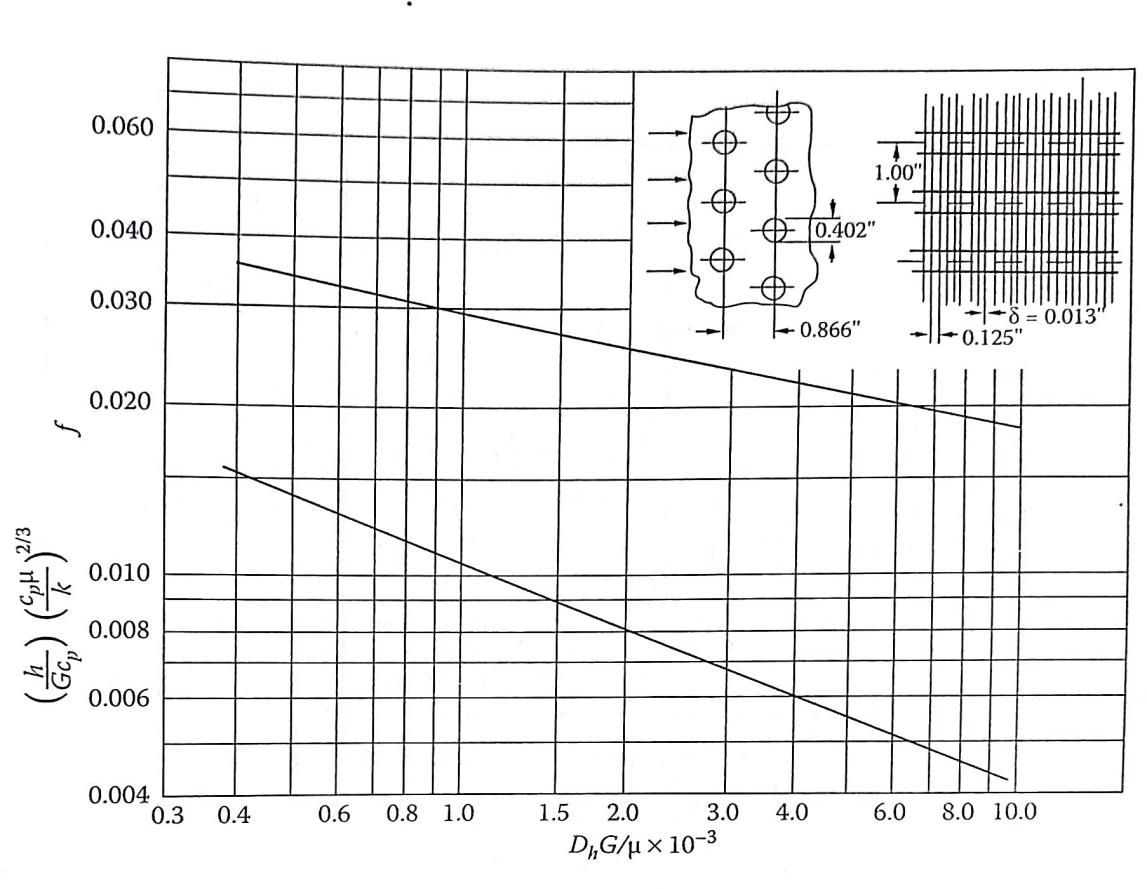
7 marks

Air at 1 atmospheric pressure and 400 K and with velocity of 10 m/s flows across a compact heat exchanger Matrix having the configuration shown in figure 1. Calculate the heat transfer coefficient and frictional pressure drop for the air side. The length of the matrix is 0.6 m.

GTU Design of Heat exchangers (3161911) Summer 2026 Question 1(c) Diagram

Q.2

14 Marks
(a)
3 marks
Discuss the main selection criteria of heat exchanger.
(b)
4 marks

Why are baffles used in shell and tube type heat exchangers? What are advantages of shell and tube construction?

(c)
7 marks

Water at a flow rate of 5000 kg/h will be heated from 20 °C to 35 °C by hot water at 140 °C. A 15 °C hot water temperature drop is allowed. A number of 3.5 m hair pins of 3 in.( ID= 0.0779 m) by 2 in.( ID = 0.0525 m, OD= 0.0603 m) counter flow double pipe heat exchanger with annuali and pipes each connected in series will be used. Hot water flows through the inner tube. Fouling factor for inner side is 0.000176 m² .K/W, and at outer side 0.000352 m² .K/W. assume that the pipe is made of carbon Steel having thermal conductivity 54 W/ m. K. The heat exchanger is insulated against heat losses. Calculate the number of hair pins.

(c)
7 marks

Explain the procedure of calculating total pressure drop in double pipe heat exchanger.

Q.3

14 Marks
(a)
3 marks
What characterizes a heat exchanger as compact?
(b)
4 marks

What are the advantages and the limitation of gasketed plate heat exchangers?

(c)
7 marks

A tubular heat exchange consists of 200 tubes each 20mm OD and 5 m length. Hot fluid flows inside the tube and cold fluid over it and in opposite direction to hot fluid. Overall heat transfer co-efficient based on OD is 320 W/ m² K. Determine the outlet temperature of both fluids using the data given below. Mass flow of hot fluid is 20 kg per second. Mass flow of cold fluid 5 kg per second. Inlet temperature of hot fluid 120° C inlet temperature of cold fluid 20° centigrade. Specific heat of hot fluid is 2000 J/Kg K. specific heat of cold fluid 4000 J/Kg K

(a)
3 marks

Name the specific heat exchanger in each of the following application. 1 power condenser 2. automatic radiator 3 Marine oil cooler

(b)
4 marks

Where are find used? What are the types of find that are used in heat exchangers?

(c)
7 marks

Find out the heat transfer area of a steam condenser conducting 10000 kg of steam per hour at 0.2 bar absolute pressure. Steam initially is dry and saturated and condensate is saturated water. The rising temperature of cooling water is 20 °C and the temperature of the available cooling water is 20 °C and the temperature difference at the outlet between steam and water is 10 °C. The overall heat transfer coefficient is 4 KW/ m² K. The flow is parallel flow.

Q.4

14 Marks
(a)
3 marks

Draw 30°, 45° and 60° tube layout angles arrangements for shell in tube heat exchanger.

(b)
4 marks

Discuss the consideration which are important in taking the decision for which fluid will flow through the tubes and which will flow through the shell.

(c)
7 marks

A two shell and four tube pass counter flow heat exchanger is used to heat glycerin from 20 °C to 50 °C by hot water which enters into a thin wall tube of 2 cm dia at 80 °C and leaves at 40 °C. The total length of the tube in the heat exchanger is 60 m. the heat transfer coefficient of glycerin side and water side are 25 W/ m² K and 160 W/ m² K respectively. determine the rate of heat transfer in the heat exchanger when

1)before any fouling occurs and
2)after fouling as outer surface with the fouling factor of 0.0006 m² K/ W.
(a)
3 marks

Why NTU method is more suitable than LMTD method in design of heat exchanger.

(b)
4 marks
Draw any four most common TEMA shell type’s sketches.
(c)
7 marks

Select one type of heat exchanger and provide a brief report on its characteristics typical areas of application advantages limitation and current status.

Q.5

14 Marks
(a)
3 marks
State the application of compact heat exchanger.
(b)
4 marks

What are enhance surfaces and what the advantages are of enhance surfaces.

(c)
7 marks

What is the use of pinch analysis explain its principle taking reference of hot and cold stream.

(a)
3 marks

Explain the effect of baffle spacing and baffle cut at shell side on heat transfer and pressure drop

(b)
4 marks
Draw any two finned tube geometry used with circular tubes.
(c)
7 marks

Hot oil is cooled by water in a one shell and 8 tube basket exchanger. Tubes are thin and made of copper with 1.4 cm in a diameter. Length of each tube pass in the heat exchanger is 5 m. water flows through the tubes at a rate of 0.2 kg per second and oil flows through the shell at a rate of 0.3 kg per second. The water enters at 20 °C and oil enters at 150 °C. Determine

1The rate of heat transfer and
2Outlet temperature of water and oil Assume overall heat transfer coefficient 310 W/m². K. and specific heat of oil 2.13 KJ/Kg K specific heat of water 4.18 KJ/Kg K Figure-1 Heat transfer and friction factor for a circular tube continuous fin heat exchanger. Surface 8.0- 3/8 T: tube OD = 1.02 cm, fin pitch = 3.15/cm, fin thickness = 0.033 cm, fin area/ total area = 0.839, air passage hydraulic dia = 0.3633 cm, free flow area/ frontal area, σ = 0.534, heat transfer area/ total volume = 587 m²/m³.
GTU Design of Heat exchangers (3161911) Summer 2026 Question 5 OR (c) Diagram

Preparing with friends?

Send this paper to your class group. Every question has its own link.

About this paper

Official Gujarat Technological University (GTU) examination paper for Design of Heat exchangers (Summer 2026, B.E. · Mechanical Engineering, Sem 6). Features complete 70-mark regular & remedial examination pattern, official marking distribution across all 5 questions, and direct 1-click official PDF download.

Transcribed for student exam preparation from Gujarat Technological University official examination archives. Questions, syllabus guidelines, and curriculum marking schemes remain the intellectual property of Gujarat Technological University.

ViewDownload PDF