Q.1
14 Marks(a)
Discuss reasons for implementing CAD in industry.
(b)
Compare Computer Aided Design with Conventional Design Process.
(c)
Explain the concept of Finite Element Method. Discuss about various steps involved in Finite Element Analysis.
Noted. This paper is in our queue now. Check back tomorrow.
We could not record that here. Email the paper name to hirenjsca@gmail.com and we will add it.
Compare Computer Aided Design with Conventional Design Process.
Explain the concept of Finite Element Method. Discuss about various steps involved in Finite Element Analysis.
Differentiate between parametric and synthetic curves. Explain various types of continuity used in synthetic curves.
A line is required to draw from (25,25) pixel to (62,44) pixel. Calculate first six positions for the same using Bresenham’s algorithm.
Explain types of projections of geometric models with neat diagram.
A rectangle ABCD having vertices A (50, 100), B (200,100), C (200,200) and D (50,200) is to be reflected about a line passing through points P (20, 20) and Q (110, 130). Determine the new vertices of the rectangle.
Formulate the rotation matrix for rotating any object about the origin.
A triangle PQR, having coordinate position of point P (0,0) Q (4,0) and R (2,3) is translate through 4 and 2 units along X and Y direction respectively and then rotated 90˚ in anticlockwise direction about new position of point R. Find new vertices of the triangle.
Explain the three forms of equations used in Johnsons’ method of optimum design.
Differentiate between wireframe modeling and solid modeling technique for CAD.
What do you understand by geometry and topology in solid modelling? Explain with neat diagram.
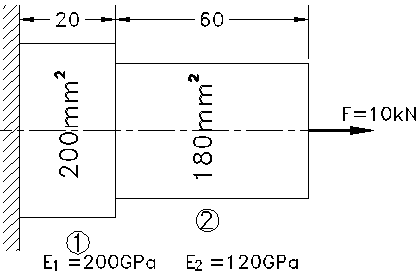
A stepped bar is made of two materials joined together as shown in figure 1. The bar is subjected to an axial pull of 10 kN. Determine displacements and stresses of each of the section, using a 1D spar element.
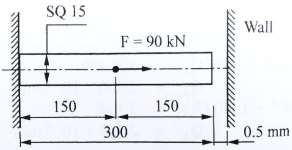
For the Loading as shown in figure 2, with the penalty approach determine the displacements and support reaction. Assume modulus of elasticity as 80 X 10³ N/mm².
BE Mechanical
Send this paper to your class group. Every question has its own link.
Official Gujarat Technological University (GTU) examination paper for Computer Aided Design (Summer 2026, B.E. · Mechanical Engineering, Sem 6). Features complete 70-mark regular & remedial examination pattern, official marking distribution across all 5 questions, and direct 1-click official PDF download.
Transcribed for student exam preparation from Gujarat Technological University official examination archives. Questions, syllabus guidelines, and curriculum marking schemes remain the intellectual property of Gujarat Technological University.
3161903 Computer Aided Design
Official GTU PDF · Summer 2026
The PDF could not be loaded from the university's website.
Open the PDF directly