Q.1
14 Marks(a)
Find the degrees of freedom for the given configurations.
i)(ii)
iii)
(b)
How are the kinematic pairs classified? Explain with examples.
(c)
Explain the inversions of the single slider crank mechanism.
Noted. This paper is in our queue now. Check back tomorrow.
We could not record that here. Email the paper name to hirenjsca@gmail.com and we will add it.
In a crank and slotted lever mechanism, the length of crank is 560 mm and the ratio of time of working stroke to return stroke is 2.8. Determine (a) distance between the fixed centres, and (b) the length of the slotted lever, if length of stroke is 250 mm.
A four bar mechanism is to be synthesized by using three precision points from Chebyshev’s spacing to generate the function y = x2, for the range 0 < x < 1. Input link is to start from 30⁰ and Δθ = 90⁰. The output link is to start at 30⁰ and Δϕ = 90⁰. Find out the values of corresponding θ and ϕ.
Design a slider crank mechanism to coordinate three positions of the input and of the slider for the following data by inversion method. Eccentricity = 20 mm. θ12 = 30⁰, θ13 = 60⁰, S12 = 40 mm, S13 = 96 mm.
In the mechanism shown in figure the crank OA rotates at 210 rpm clockwise. For the given configuration, determine
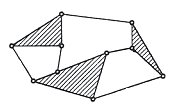
Figure shows a six link mechanism. The dimensions of the links are OA = 100 mm, AB = 450 mm, BD = 200 mm, QB = 400 mm, DE = 200 mm, CE = 200 mm. Find all the I-Centers for the given configuration. Also find velocity of point B and E and an angular velocity of links CE and BQ. Link OA rotates at 20 rad/s clockwise.
A cam is to operate an offset roller follower. The least radius of the cam is 50 mm, roller diameter is 30 mm, and offset is 20 mm. The cam is to rotate at 360 rpm. The angle of ascent is 48°, angle of dwell is 42°, and angle of descent is 60°. The motion is to be SHM during ascent and uniform acceleration and deceleration during descent. Draw the cam profile.
Calculate the maximum velocity and acceleration during return for the data given in Q.4 (c) above.
An open belt drive is required to transmit 10kW of power from a motor running at 600 rpm. Diameter of the driving pulley is 250 mm. The speed of the driven pulley is 220 rpm. The belt is 12 mm thick and has a mass density of 0.001 g/mm². Safe stress in the belt is not to exceed 2.5 N/mm². The two shafts are 1.25 m apart. The coefficient of friction is 0.25. Determine the width of the belt.
A differential band brake has a drum with a diameter of 800 mm. The two ends of the band are fixed to the pins on the opposite sides of the fulcrum of the lever at distances of 40 mm and 200 mm from the fulcrum. The angle of contact is 270⁰ and the μ = 0.2. Determine the brake torque when a force of 600 N is applied to the lever at a distance of 800 mm from the fulcrum. Consider clockwise rotation of the drum.
Two 20⁰ involute spur gears mesh externally and give a velocity ratio of
A single-plate clutch, with both sides effective, has inner and outer diameters of friction surface 250 mm and 350 mm, respectively. The maximum intensity of pressure is not to exceed 0.15 MPa. The coefficient of friction is 0.3. Determine the power transmitted by the clutch at a speed of 2400 rpm for (a) uniform wear and (b) uniform pressure.
BE Mechanical
Send this paper to your class group. Every question has its own link.
Official Gujarat Technological University (GTU) examination paper for Kinematics and Theory of Machines (Summer 2025, B.E. · Mechanical Engineering, Sem 3). Features complete 70-mark regular & remedial examination pattern, official marking distribution across all 5 questions, and direct 1-click official PDF download.
Transcribed for student exam preparation from Gujarat Technological University official examination archives. Questions, syllabus guidelines, and curriculum marking schemes remain the intellectual property of Gujarat Technological University.
3131906 Kinematics and Theory of Machines
Official GTU PDF · Summer 2025
The PDF could not be loaded from the university's website.
Open the PDF directly