Q.1
14 MarksDefine an operational amplifier. List the four key building blocks inside a typical op- amp and state the primary function of each.
Name and describe three basic IC package types. Which is exclusively used for digital ICs?
Noted. This paper is in our queue now. Check back tomorrow.
We could not record that here. Email the paper name to hirenjsca@gmail.com and we will add it.
Define an operational amplifier. List the four key building blocks inside a typical op- amp and state the primary function of each.
Name and describe three basic IC package types. Which is exclusively used for digital ICs?
What are the benefits of using negative feedback in an op-amp circuit? List at least four advantages.
Explain the current-to-voltage converter derived from the inverting amplifier. Write its output voltage equation.
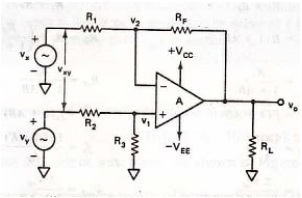
For the differential amplifier of Fig: R1=R2=1kΩ, RF=R3=10kΩ, op-amp is 741C.

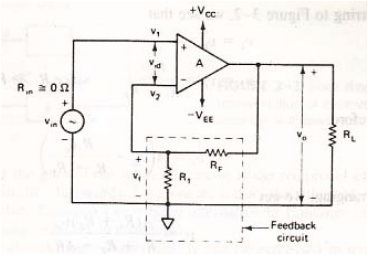
A 741C op-amp is connected as a noninverting amplifier with R1 = 1 kΩ, RF = 10 kΩ. Given: A = 200,000, Ri = 2 MΩ, Ro = 75 Ω, fo ≅ 5 Hz, output swing = ±13 V. Calculate AF, RiF, RoF, fF, and VooT.

What is an offset voltage-compensating network? Why is it necessary before using an op-amp as a dc amplifier?
Write the expression for total output offset voltage VooT for (a) an amplifier without ROM and (b) an amplifier with ROM.
Define error voltage Ev for an inverting amplifier. Derive the expression for Ev due to thermal drift in Vio and Iio.
Define Supply Voltage Rejection Ratio (SVRR). Express it in μV/V and in dB. Give an example conversion.
At what range of supply voltages does the open-loop voltage gain of the 741C vary at TA = 25°C? Why is a higher open-loop gain desirable?
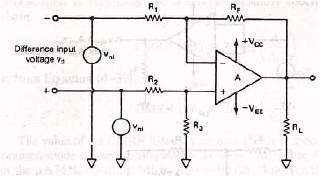
In the differential amplifier of Figure, R1=R2=1 kΩ, RF=R3=10 kΩ, vd=5 mV sine at 1 kHz, vni=2 mV at 60 Hz. Op-amp is μA741 with CMRR=90 dB. Find (a) output at 1 kHz and (b) noise at output at 60 Hz.

What is the fundamental difference between a DC amplifier and an AC amplifier using an op-amp? When is an AC amplifier preferred over a DC amplifier?
Draw the circuit diagram of an AC inverting amplifier using a 741 op-amp with a coupling capacitor. Derive the expression for its low-frequency cutoff fL.
Derive the expression for peak frequency fp, peak gain AF, and bandwidth BW of a peaking amplifier. State conditions for each formula.
What are the desirable characteristics of an instrumentation amplifier? Name two dedicated instrumentation op-amp ICs.
Draw the inverting summing amplifier circuit with three inputs Va, Vb, Vc. Derive the output voltage expression.
Explain the frequency response of a practical integrator. Define fa and fb. In what frequency range does it act as a true integrator?
List the important characteristics required for an op-amp to be used as a comparator. Explain why a wide bandwidth is necessary.
Explain the operation of a 555 Timer configured as a monostable multivibrator along with the capacitor voltage and output waveforms.
What are the advantages of adjustable voltage regulators (like LM317) over fixed voltage regulators?
In an astable multivibrator using a 555 timer, calculate the positive pulse width, negative pulse width, and free-running frequency if RA = 2.2 kΩ, RB = 3.9 kΩ and C = 0.1 μF.
BE EC
Send this paper to your class group. Every question has its own link.
Official Gujarat Technological University (GTU) examination paper for Linear Integrated Circuits (Summer 2026, B.E. · EC Engineering, Sem 4). Features complete 70-mark regular & remedial examination pattern, official marking distribution across all 5 questions, and direct 1-click official PDF download.
Transcribed for student exam preparation from Gujarat Technological University official examination archives. Questions, syllabus guidelines, and curriculum marking schemes remain the intellectual property of Gujarat Technological University.
BE04000051 Linear Integrated Circuits
Official GTU PDF · Summer 2026
The PDF could not be loaded from the university's website.
Open the PDF directly