Gujarat Technological UniversitySummer 2025 examination

GTU 3170511 Transport Phenomena Summer 2025 Question Paper & PDF

B.E. · Chemical Engineering · Semester 7 · Subject code 3170511
Download official PDFView PDF here
Share with your class
Total
70 marks
To pass
23 marks (33%)
Duration
2.5 Hours 2:30 PM – 5:00 PM
Questions
5 with internal choice
No solutions on this paper yetNeed them for your exam? Ask once. Papers that students ask for are solved first, and we aim to add them within 24 hours.

Q.1

14 Marks
(a)
3 marks
Write an expression for combined heat, mass and momentum transport.
(b)
4 marks

Compute the mean molecular velocity ū (in cm/s) and the mean free path λ (in cm) for oxygen at 1 atm. and 273.2 K. A reasonable value for diameter is 3 Å. What is the ratio of the mean free path to the molecular diameter under these conditions? What would be the order of magnitude of the corresponding ratio in the liquid state?

(c)
7 marks

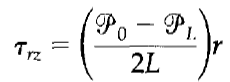
For a steady-state axial flow of an incompressible liquid in a circular pipe, The Momentum flux profile is given by Find the Velocity profile as a function of r. Also, find

1The maximum velocity
1The average velocity
2The mass flow rate
3The force exerted by the fluid on the solid surfaces.
Q.2

14 Marks
(a)
3 marks

What are Boundary conditions? Write commonly used boundary conditions for energy transport.

(b)
4 marks

Write the equation for Fourier’s law of heat conduction. Explain the case where thermal conductivity and effective thermal conductivity are used.

(c)
7 marks

Develop the shear stress and velocity distribution profile for the laminar flow through the annulus. State assumptions made while deriving these expressions.

(c)
7 marks

Develop an expression for the equation of continuity involving cylindrical coordinates.

Q.3

14 Marks
(a)
3 marks
Write an expression for the following:
1Convective energy flux vector
2Molecular work flux vector
3Molecular heat flux vector
(b)
4 marks

Define thermal diffusivity. The wall of an industrial furnace is constructed from 0.15 m thick fireclay brick having a thermal conductivity of 1.7 W/m.K. Measurements made during steady-state operation show 1400 and 1150 K at the inner and outer surfaces, respectively. What is the rate of heat loss through a wall of 0.5 m × 1.2 m on a side? Assumptions

1)One-dimensional conduction
2)Steady-state conditions
3)Constant properties.
(c)
7 marks

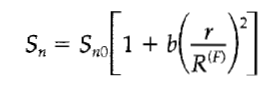
Develop the heat flux and temperature distribution profile for heat conduction involving nucleus heat source Sn. State assumptions made while deriving these expressions.

(a)
3 marks

How thermal conductivity of a material is affected by its size, shape and composition?

(b)
4 marks

Compare the temperature dependence of the thermal conductivities of gases, liquids, and solids.

(c)
7 marks
iAn oil acting as a lubricant for a pair of cylindrical surfaces is shown in Fig. The differential form of energy balance expression is given as Where C1 is constant term. Assume linear velocity profile in the above differential expression and develop a profile for a temperature of the fluid as a function of x using appropriate boundary conditions.
iiThe angular velocity of the outer cylinder is 7908 rpm. The outer cylinder has a radius of 5.06 cm, and the clearance between the cylinders is 0.027 cm. What is the maximum temperature in the oil if both wall temperatures are known to be 70°C? The physical

properties of the oil are assumed constant at the following values: Data : Viscosity: 92.3 cp Density: 1.22 g/cm³ Thermal conductivity: 0.0055 Cal /s.cm. C

GTU Transport Phenomena (3170511) Summer 2025 Question 3 OR (c) Diagram

Q.4

14 Marks
(a)
3 marks
Write in brief about Mass average and molar average velocity.
(b)
4 marks
Discuss Fick’s law of diffusion with a suitable diagram.
(c)
7 marks

A graduated cylinder cross-sectional diameter of 0.01128 m containing chloropicrin (CC13NO2) is placed in a hood. The hood has a blower system that continually circulates dry air at a constant temperature (25°C) and pressure (atmospheric). Originally, the liquid surface was 0.0388 m from the top of the cylinder. After one day the liquid level is 0.0412 m below the top. If the vapour pressure and density of chloropicrin are 3178.3 N/m² and 1650 kg/m³ respectively, estimate the substance diffusivity in air. The molecular weight of chloropicrin is 164.39 Kg/Kmol.

(a)
3 marks

Define the following

1Molecular mass flux
2Convective mass flux
(b)
4 marks

What is the role of boundary conditions in shell mass balance? State the common boundary conditions for shell mass balance.

(c)
7 marks

A tank containing 15 mole % of CO2 in air is connected to a second tank containing only air. The connection line is 5 cm in diameter and 30 cm long, as shown in Fig. Both tanks are at 1 atmospheric pressure and 298.15 K. The volume of each tank is large compared to the volume of gas in the 30 cm connection line so concentration changes in each tank are negligible for a very long time after the beginning of the experiment. The diffusion coefficient of CO2 in air at 1 atm. and 25°C is 0.164×10⁴ m2 s-l. Calculate the initial rate of mass transfer of the CO2? Assume that both gases are ideal and the diffusional transfer is equimolar counter diffusion.

GTU Transport Phenomena (3170511) Summer 2025 Question 4 OR (c) Diagram

Q.5

14 Marks
(a)
3 marks

Define the following

1Self-diffusion
2Biot Number
3Lewis number
(b)
4 marks

How does the equation of change differ in single-component and multicomponent systems?

(c)
7 marks

Derive an expression for heat flux and temperature profile involving heat conduction in electric heat.

(a)
3 marks

Define the following

1Brinkman Number
2Thiele modulus
3Schmidt Number
(b)
4 marks

Discuss the effect of temperature and pressure on Diffusivity for

1Binary gas mixtures
2Liquid
(c)
7 marks

Distinguish between homogeneous and heterogeneous reactions. Discuss phenomena of diffusion-controlled reaction with a suitable example.

More Transport Phenomena papers

Questions repeat across sessions. Working through two or three papers shows you which topics GTU asks most.

Preparing with friends?

Send this paper to your class group. Every question has its own link.

About this paper

Official Gujarat Technological University (GTU) examination paper for Transport Phenomena (Summer 2025, B.E. · Chemical Engineering, Sem 7). Features complete 70-mark regular & remedial examination pattern, official marking distribution across all 5 questions, and direct 1-click official PDF download.

Transcribed for student exam preparation from Gujarat Technological University official examination archives. Questions, syllabus guidelines, and curriculum marking schemes remain the intellectual property of Gujarat Technological University.

ViewDownload PDF