Q.1
14 MarksOut of the integers 1 to 1000. How many of them are neither divisible by 3, nor by 5 nor by 7?
Also asked in Winter 2025 Q2c
Let , , be the numbers in 1 to 1000 divisible by 3, 5 and 7. Use the inclusion-exclusion principle.
Numbers divisible by two of them are divisible by the product (15, 21, 35). Numbers divisible by all three are divisible by 105.
Numbers divisible by none of 3, 5, 7: .
457 integers are divisible by none of 3, 5 and 7.
- Complete graph: a simple graph in which every two distinct vertices are joined by an edge. A complete graph on vertices has edges. Example: has 4 vertices and 6 edges.
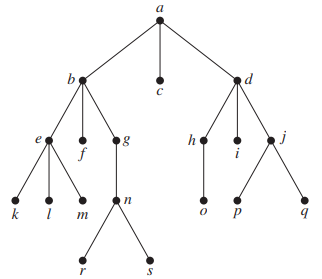
- Tree: a connected graph with no cycle. It has exactly one path between any two vertices, and a tree with vertices has edges. Example: a path with a branch .
- Adjacency matrix: for a graph with vertices, an matrix whose entry is 1 if and are joined by an edge, and 0 otherwise. It tells at a glance which vertices are neighbours. Example: for the path :
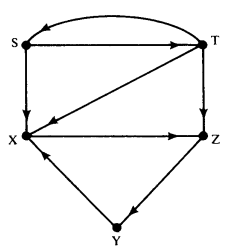
- Strongly connected graph: a directed graph in which there is a directed path from every vertex to every other vertex. Example: a directed triangle .
Define partition of a set. Let a relation R is defined by xRy iff (x-y) is divisible by 5. Then show that R is an equivalence relation. Also, find the all distinct partition for R.
A partition of a set is a collection of non-empty, pairwise disjoint subsets of whose union is . Every element of lies in exactly one of the subsets. Example: is a partition of , because the three subsets do not overlap and together contain all five numbers.
Here is defined on the set of integers by if and only if . In words, two integers are related when their difference is a multiple of 5. For example, because .
R is an equivalence relation
An equivalence relation is reflexive, symmetric and transitive.
- Reflexive: for any , , and . So .
- Symmetric: let . Then for some integer . So , which is divisible by 5. So .
- Transitive: let and . Then and . Adding, , which is divisible by 5. So .
is reflexive, symmetric and transitive, so it is an equivalence relation.
Distinct equivalence classes
The class of is . Two integers are in one class when they leave the same remainder on division by 5. The possible remainders are 0, 1, 2, 3 and 4, and each one gives a different class, so there are exactly 5 classes.
These classes do not overlap, and together they cover all of . This is a general fact: the equivalence classes of any equivalence relation form a partition of the set. So the partition for is , and there is no other distinct partition for this relation.
is reflexive, symmetric and transitive, so it is an equivalence relation, and it partitions into the 5 classes .